


Our goal is to become your true partner in the field of thermal pad China. Xiamen Jonny Electronics Co., Ltd. is a high-tech enterprise dedicated to the research and development, production and provision of thermal management solutions for thermal conductive materials. We are committed to green products that comply with ROHS, REACH, UL certification standards. We have a strong R&D team to regularly update our new products according to customers' requirements.
Why Choose Us
Our Certifications
JOINY has obtained multiple certifications and quality systems, and complies with corporate social responsibility standards such as BSCI, as well as quality management systems such as IATF 16949, ISO 9001:2015 and ISO 1400.
Product Applications
Our products are thermal pads, thermal gels, thermal greases, potting compounds, conformal coatings and adhesives. They have excellent heat dissipation and conductivity, and are ideal for electronic components and thermal management.
Our Services
The company has a professional sales team to provide you with high-quality pre-sales consulting services. During the order production process, customers can communicate with us at any time to understand the production progress. At the same time, we provide high-quality after-sales service to meet the different needs of customers.
-
![Thermal Pad For Processor]()
-
![Thermal Pad in Pcb]()
-
![Thermal Pad For Phone]()
-
![Thermal Interface Material Pad]() Thermal Interface Material PadThermal interface material pad plays a crucial role in maintaining optimal temperature conditions for electronic devices, ensuring their efficient operation. Our thermal pads are engineered withread more
Thermal Interface Material PadThermal interface material pad plays a crucial role in maintaining optimal temperature conditions for electronic devices, ensuring their efficient operation. Our thermal pads are engineered withread more -
![Cooling Thermal Pad]()
-
![Thermal Pad 0.5 mm]()
-
![Thermal Grizzly Thermal Pad]()
-
![Thermal Pad 3mm]()
-
![Thermal Pad For Heat Sink]()
-
![Bergquist Thermal Pad]()
-
![Thermally Conductive Silicone Sheet]() Thermally Conductive Silicone SheetA thermally conductive silicone sheet is a kind of high-performance thermal management material, mainly composed of silicone rubber and thermally conductive fillers.A thermally conductive siliconeread more
Thermally Conductive Silicone SheetA thermally conductive silicone sheet is a kind of high-performance thermal management material, mainly composed of silicone rubber and thermally conductive fillers.A thermally conductive siliconeread more -
![Pink Thermal Pad]()


Advantages of Thermal Pad
Heat Transfer Efficiency: Thermal conductive pads are designed to have high thermal conductivity, which allows them to efficiently transfer heat from the heat source to a heat sink or other cooling mechanisms. They provide a direct thermal pathway, minimizing thermal resistance and promoting effective heat dissipation.
Easy Application: Thermal conductive pads are typically pre-cut or available in sheet form, making them easy to handle and apply. They can be conveniently placed between heat-generating components and heat sinks without the need for additional adhesives or complex installation processes. This simplifies the assembly and saves time during device manufacturing or maintenance.
Electrical Insulation: Many thermal conductive pads are electrically insulating, which means they prevent electrical conductivity between components. This feature is particularly important in electronic devices where there is a risk of short circuits or electrical interference. The insulating properties of thermal pads help ensure the safety and integrity of the system.
Compression and Conformability: Thermal conductive pads are often compressible, allowing them to conform to uneven or irregular surfaces. When pressure is applied, they fill gaps and imperfections, creating better contact and improving thermal conduction. This feature helps eliminate air gaps that can impede heat transfer and ensures uniform heat distribution across the interface.
Vibration and Shock Absorption: Some thermal conductive pads have additional properties, such as vibration damping or shock absorption. These pads help reduce the impact of mechanical vibrations or shocks on the components, providing added protection and enhancing the overall reliability of the system.
Reusability: Certain types of thermal conductive pads can be reused multiple times, which can be advantageous in scenarios where components need to be disassembled and reassembled. The ability to reuse thermal padsreduces material waste and can result in cost savings over time.
Applications of Thermal Pad
CPU and GPU cooling
In modern computers and graphics processing equipment, the CPU and GPU are the heart and brain of the device. They generate a lot of heat during operation. They require effective heat dissipation to ensure stability and performance.
Power MOSFET cooling
Power MOSFETs are key components in the power supply. They are responsible for switching and converting electrical energy. They also generate a certain amount of heat when working.
Power module heat dissipation
Thermal pads are used to transfer the heat generated inside the power supply module to the heat sink. This ensures that the power supply module continues to provide power in a stable manner and extends its life.
Heat dissipation of other electronic components
Thermal pads are not only limited to CPUs, GPUs, MOSFETs, and power modules. They are also widely used for other electronic components, such as inductors and capacitors.
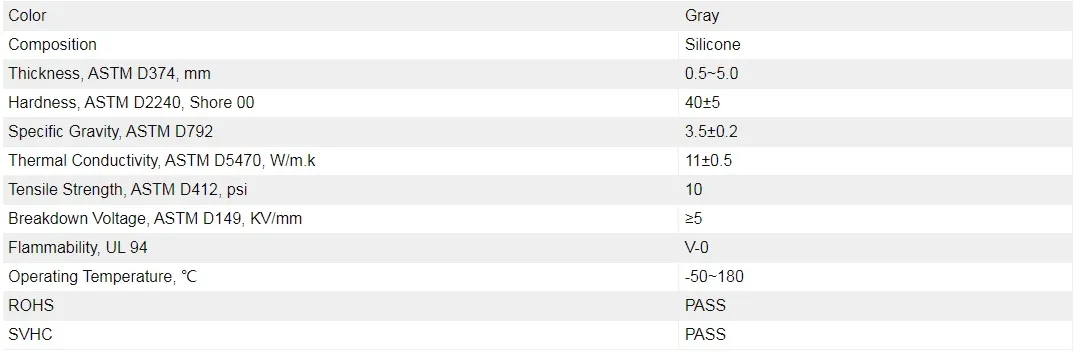
Typical Properties of Thermal Pad

Types of Thermal Pad
Silicone-based Thermal Pads: These pads are the most widely used in the industry, owing to their good thermal conductivity and cost-effectiveness. They are also easy to install.
Graphite Thermal Pads: These pads are made from a blend of graphite and a binder material. They have good thermal conductivity and can be used in high-temperature applications.
Ceramic Thermal Pads: These pads are made from a blend of ceramic particles and a binder material. They have excellent thermal conductivity and can be used in applications with high-pressure loads.
Carbon Fiber Thermal Pads: These pads are made from carbon fiber, which has excellent thermal conductivity. They are ideal for applications where high durability is required.
Phase Change Thermal Pads: These pads have a special formulation that changes from a solid state to a liquid state when heated. They have excellent thermal conductivity and can conform to the shape of the component, ensuring optimal heat transfer.
Normally, thermal pads are square and have a specific size, which rarely fits the requirements. We offer to cut thermal pads into exactly the size needed for your particular application. Additionally, it is also possible to do cuts at custom angles, giving more flexibility for complex designs.
Materials of Thermal Pad
Thermal pads come in a variety of materials. They're often based on silicone or other thermally conductive materials, such as Kapton or PEN film. Silicone is a highly versatile material and can be manufactured to a variety of thicknesses. You can use it to fill large gaps or small spots on a component or to transfer heat between two surfaces.
Other Service of Thermal Pad
|
Selling Units |
Single item |
|
Packaging |
With pet film or foam-for protection Use paper card to separate each layer |
|
Online-service |
12 Hours , Inquiry reply within fastest |
FAQ
As one of the most professional thermal pad manufacturers and suppliers in China, we're featured by quality products and low price. Please rest assured to buy cheap thermal pad from our factory.
thermal contact pad, High Thermal Conductivity Silicone Pad, thermal design pad