

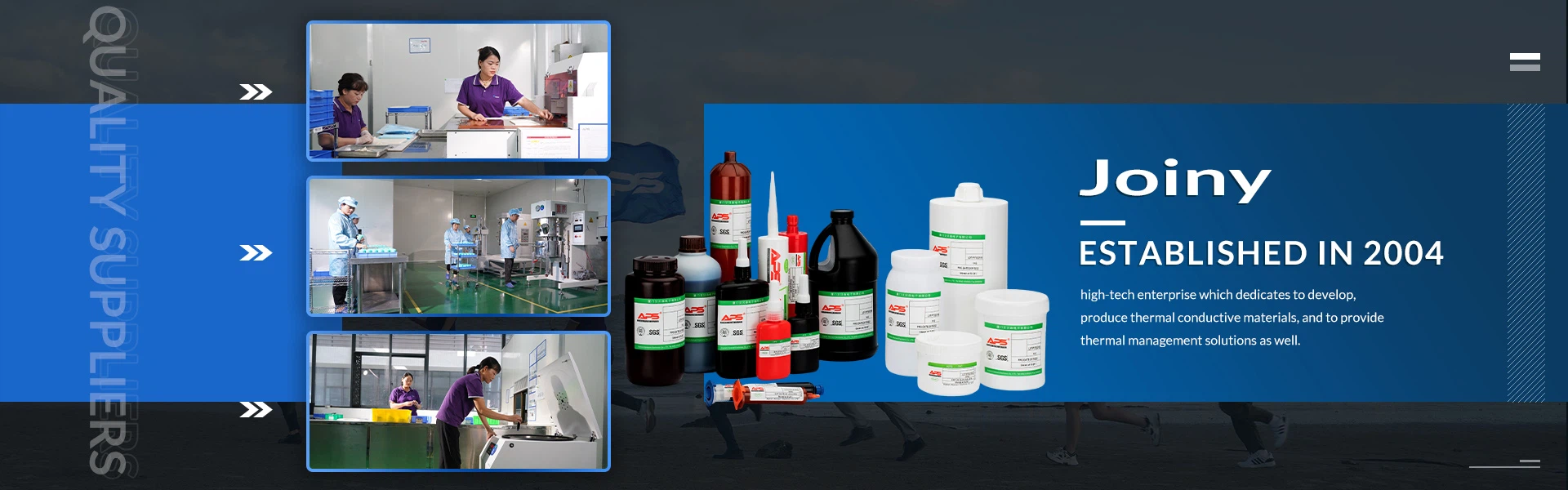
Our goal is to become your true partner in the field of adhesive China. Xiamen Jonny Electronics Co., Ltd. is a high-tech enterprise dedicated to the research and development, production and provision of thermal management solutions for thermal conductive materials. We are committed to green products that comply with ROHS, REACH, UL certification standards. We have a strong R&D team to regularly update our new products according to customers' requirements.
Why Choose Us
Our Certifications
JOINY has obtained multiple certifications and quality systems, and complies with corporate social responsibility standards such as BSCI, as well as quality management systems such as IATF 16949, ISO 9001:2015 and ISO 1400.
Product Applications
Our products are thermal pads, thermal gels, thermal greases, potting compounds, conformal coatings and adhesives. They have excellent heat dissipation and conductivity, and are ideal for electronic components and thermal management.
Our Services
The company has a professional sales team to provide you with high-quality pre-sales consulting services. During the order production process, customers can communicate with us at any time to understand the production progress. At the same time, we provide high-quality after-sales service to meet the different needs of customers.
-
![Thermal Coumpound Paste]() Thermal Coumpound PasteJNY8501 is two part, additional type, flame retardant and thermal conductive silicone potting compound. It could be cured in room temperature also the heat condition. After cure, it is repairable andread more
Thermal Coumpound PasteJNY8501 is two part, additional type, flame retardant and thermal conductive silicone potting compound. It could be cured in room temperature also the heat condition. After cure, it is repairable andread more

Advantages of Potting Compound
Protection from environmental factors
Potting compounds can protect electronic components from moisture, dust, dirt, and other environmental factors that can damage them.
Improved mechanical stability
Potting compounds can also provide mechanical stability to electronic components and circuitry, reducing the risk of damage due to vibration, shock, and other mechanical stresses.
Enhanced thermal management
Some potting compounds have high thermal conductivity and can help dissipate heat generated by electronic components, reducing the risk of overheating and damage.
Chemical resistance
Potting compounds can be formulated to resist chemical exposure and degradation, which is important for components exposed to harsh chemicals or solvents.
Applications of Potting Compound
Electronics: One of the primary users of potting compounds is the electronics industry. Potting compounds protect sensitive electronic components such as circuit boards, sensors, and connectors from moisture, corrosion, and mechanical damage.
Automotive: In automotive manufacturing, potting compounds protect electronic control units (ECUs), sensors, and wiring harnesses from harsh operating conditions, including extreme temperatures, humidity, and vibration.
Aerospace and Defense: Potting compounds are crucial in aerospace and defense applications where electronic systems operate in demanding environments such as high altitudes, fluctuating temperatures, and chemical exposure.
Renewable Energy: The renewable energy sector, including solar and wind power generation, relies on potting compounds to safeguard electrical components like inverters, controllers, and sensors in renewable energy systems.
Medical Devices: Potting compounds manufacture medical devices to protect electronic components embedded in devices such as pacemakers, defibrillators, and diagnostic equipment.
Telecommunications: In telecommunications infrastructure, potting compounds protect sensitive electronic equipment like amplifiers, transceivers, and antennas from moisture, temperature variations, and physical damage.

Types of Potting Compound
Epoxy Potting Compounds: Epoxy resins have earned their place in electronics due to their robust combination of qualities. Resistance to elevated temperatures, making them a good option for environments that reach up to 180°C. For instance, epoxy potting is widely applied in electric motors. These motors generate substantial heat and undergo constant mechanical vibrations, which can damage sensitive components. Epoxy provides the necessary insulation and protection, ensuring that the motor operates reliably over time, while also preventing electrical short circuits.
Silicone Potting Compounds: Silicone compounds excel in environments where flexibility and temperature extremes are the norm. Exceptional temperature tolerance, operating efficiently in conditions from -50°C to 200°C. Reworkability, meaning that silicone can be more easily removed and reapplied compared to other potting compounds, making it ideal for applications where future repairs or modifications are anticipated.
Polyurethane (PU) Potting Compounds: Polyurethane, with its elastomeric nature, balances flexibility and mechanical strength. Adjustable curing times, which makes it easier to customize the processing speed to fit manufacturing timelines.For instance, polyurethane finds favor in automotive sensors, where components are exposed to constant vibration and moderate temperature shifts.
Specification of Potting Compound
|
Item |
SC-8501 |
|
|
Uncured |
Appearance |
Part A: black; Part B:white |
|
Gravity(g/ml) |
Part A: 1.57-1.60; Part B: 1.57-1.60 |
|
|
Viscosity( 25°C / cP) |
Part A: 3000±500; Part B:2400±500 |
|
|
Mix ratio (by weight) |
1:1 |
|
|
Mix viscosity( 25°C /cp) |
2900±500 |
|
|
Operational time( 25°C /h) |
1 |
|
|
Completely curing time(25°C/ h) |
6-8 |
|
|
Heat curing time(80°C/min) |
20-40 |
|
|
Cured |
Strength of extension/MPa |
≥1.2 |
|
Elongation at break /% |
≥180 |
|
|
Linear shrinkage /% |
≤0.3 |
|
|
Dielectric strength(Kv/mm) |
≥20 |
|
|
Volume resistivity /Ω.cm |
≥1.0×10¹⁴ |
|
|
Working temperature (°C) |
-50~200 |
|
|
Hardness(shore A) |
55±5 |
|
There are several techniques that can be used to eliminate significant air inclusions in the potting compound, the most effective being vacuum mixing and dispensing. The potting compound is prepared and mixed under a vacuum which causes any air bubbles to rise to the surface. It is then pumped into dispensing syringes via a pressurized system that does not allow air to re-enter into the compound.
The first of these is the correct potting process; firstly, the case is partly filled with the potting compound, then the pre-tested and assembled PCB is inserted into the case and the case filled almost to the top. The partly-completed converter is then placed in a resting oven which is warm, but held below the curing temperature of the compound. The potting compound becomes very liquid at the warm temperature and any trapped air bubbles rise to the surface and, if necessary, the case can be placed on a shaker table to encourage the bubbles to rise. Finally, the converter case is filled completely and transferred to a curing oven at a higher temperature.
Components of Potting Compounds
Resin: Resins serve as the matrix or binder in potting compounds. They are typically polymers like epoxies, silicones, polyurethanes, or acrylics.
Hardener or Catalyst: Resins often require a hardener or catalyst to initiate curing. This component reacts with the resin to form a cross-linked network, providing the material with its final strength and rigidity.
Fillers: Fillers are added to potting compounds to modify their physical properties and reduce costs. Joint fillers include silica, alumina, glass fibers, and mineral powders.
Plasticizers: Plasticizers are additives that improve the flexibility and elongation of potting compounds. They help prevent the material from becoming too brittle, especially when exposed to temperature variations.
Adhesion Promoters: Adhesion promoters enhance the bonding between the potting compound and substrates such as metals, ceramics, or plastics. They improve adhesion by creating chemical bonds or increasing surface roughness.
Flame Retardants: Flame retardants are essential for ensuring the safety of electronic devices, particularly in applications where fire hazards are a concern. They inhibit or suppress the combustion process, reducing the spread of flames.
Colorants and Additives: Colorants are sometimes added to potting compounds for identification or aesthetic purposes.
Packaging of Potting Compound
|
Packaging of thermal gel |
Carton boxes |
|
Packaging Details |
7.5Kg/drum, 25kg/drum package. |
FAQ
As one of the most professional potting compound manufacturers and suppliers in China, we're featured by quality products and low price. Please rest assured to buy cheap potting compound from our factory.
sealing material for wind turbines, gray potting compound, potting compound for energy storage systems